Sunday, 11 June 2017

Visits to Mum's garden and Cranford Park this weekend

Yesterday I popped over to Mums and had a wander around her very lush garden.
I found a Speckled Bush Cricket nymph.....

 
a young possible 3rd instar Green Shieldbug.....

 
but the only hoverflies I could find were all Eupeodes species.....


The high-light of my visit was this beautiful Stock Dove that came down to the feeders,
a possible garden patch tick....

 
As I was away last weekend in Rhyl my good friend Nathalie covered the Cranford Park butterfly transect for me. Although the sun was shining for most of it the wind was quite strong and gusty.
 
Her tally for the 3rd June - 12 butterflies / 5 species
 
Holly Blue x 1
Red Admiral x 3
Comma x 2
Speckled Wood x 3
Small Heath x 3
 
I completed the transect this morning while the sun was shining and the wind was fairly light.
 
My tally today - 33 butterflies / 7 species
 
Large Skipper x 3
Green-veined White x 2
Red Admiral x 4
Small Tortoiseshell x 1
Comma x 2
Speckled Wood x 11
Meadow Brown (first of the year) x 10
 
 
Meadow Brown

Meadow Brown

Large Skipper

Large Skipper

very fresh Comma

tatty and older Comma

Comma face
By the orchard I could hear a lot of young birds squeaking and after shuffling about a bit and peering in to the ivy I could see at least three very young fledgling Wrens....


Plenty of ladybirds around today but they were all 7-spot and Harlequins. There were also a lot of larvae around too of both species.
 
adult 7-spot

larva 7-spot

larva Harlequin
 
 I counted over 10 Black and Yellow Longhorn beetle (Rutpela maculate), the first ones I've seen this year...
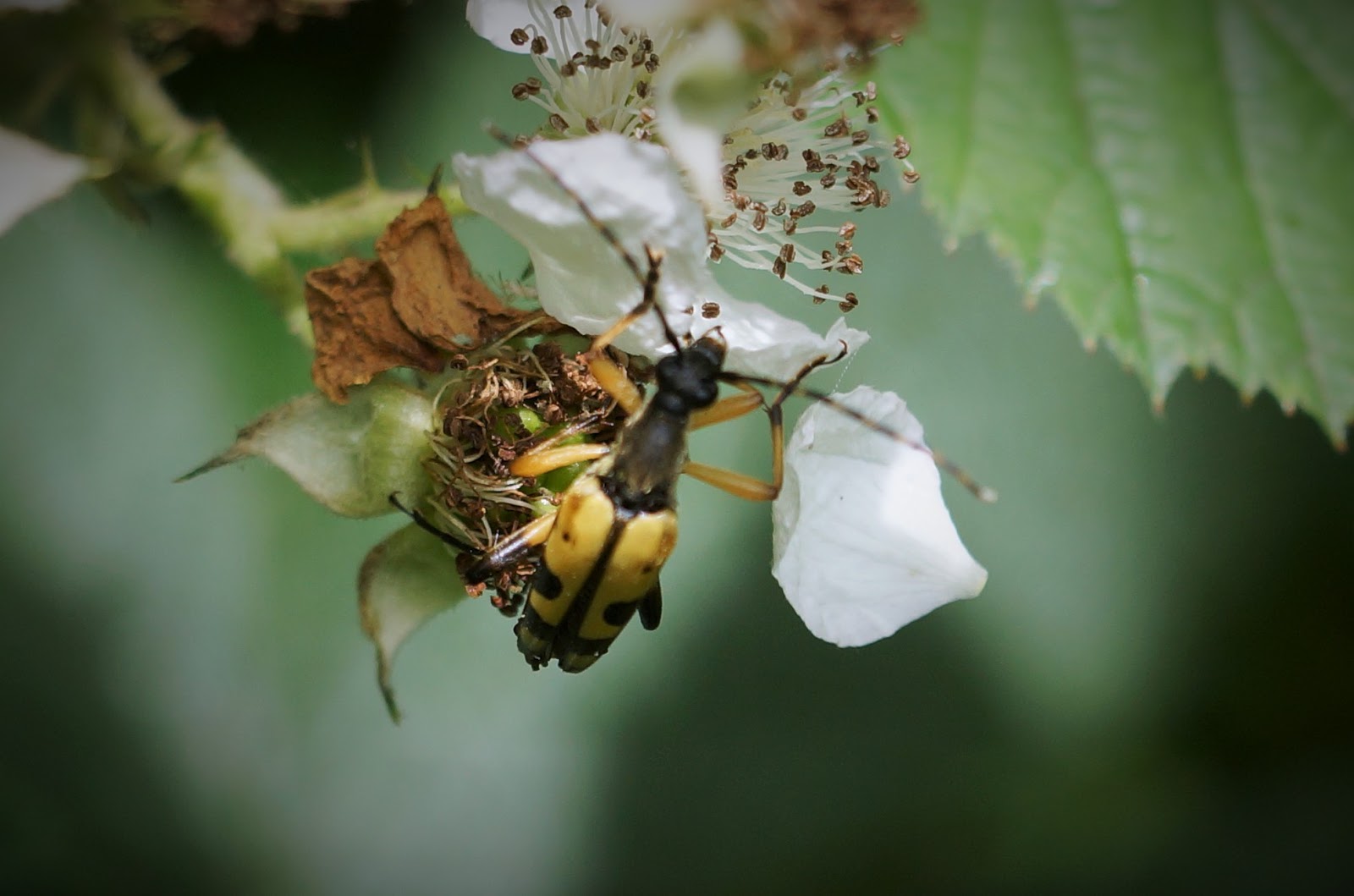


All of the wild honeybee hives are still active, with the one in the bricked up archway being the most viewable.....

 
Although the first buddleia along the M4 wall is in flower there were no critters on there except honeybees. All of the hoverflies I found today were on the flowering brambles or nettles.
 
Heliophilus pendulus

Episyrphus balteatus

tentative ID and awaiting confirmation - Cheilosia illustrate
edit - confirmed correct

Syrpus species
Other wildlife seen today at Cranford Park:-
Red Kite
Common Buzzard
Common Whitethroat
Blackcap
Skylark
Linnet
Goldfinch
Swift
Swallow
Chaffinch
 
I had hoped for a sighting of the Little Owls. The young owlets should now be visible but the park was very busy today, and I'm wondering if they were hiding from public view. Next weekend I need to do an early start at the park when it's a bit quieter.


Monday, 5 June 2017

In just one little corner of the garden......plus a walk along Rhyl beach

 
I was on babysitting duties for my cousins in Rhyl this weekend, and therefore a little restricted as to where I could go with the camera. Luckily I didn't have to go far. I just visited this one corner of my cousins garden, and clocked up an impressive number of critters as the next load of photos will show.
 
Six species of Ladybird
Five species of Hoverfly
Two harmless wasp species
plus a few ladybird and sawfly larvae


Are you sitting comfortably ?
 
7-spot ladybird (Coccinella septempunctata)
 
 
2-spot ladybird (Adalia bipunctata)


Harlequin ladybirds (Harmonia axyridis)


14-spot ladybird (Propylea quattuordecimpunctata)


10-spot ladybird (Adalia decempunctata)


Pine ladybird (Exochomus quadripustulatus)


and there were several ladybird larva. They look to all be 2-spot ladybird late-instar larva...


Other delightful eye catching critters included this Potter wasp (Odynerus sp)


Potter wasps are medium to large sized wasps measuring between 9 to 20 millimetres in length. They are black with white, yellow, orange, or red markings. The adults feed on flower nectar and collect small caterpillars to feed their young. The caterpillars are paralyzed with the wasp’s sting and piled into the brood cell (which is the compartment in which the wasp larvae develops).
The female wasp then lays an egg on the stored caterpillars. The Potter wasp larvae consumes from 1 to 12 caterpillars as it grows. Potter wasps are important in the natural control of caterpillars.
 
As to be expected in a sheltered sunny garden there were a good selection of harmless hoverflies....
 
Episyrphus balteatus
 
 
Myathropa florea


Eupeodes luniger

 
Eristalis pertinax

 
Other wiggly critters included these sawfly larva....


and this beauty below is a type of Ichneumon wasp, another harmless species. With help from Stu Hasjcore Wolfe on the Insects of Britain and Northern Europe Facebook group, it has been narrowed down to Syrphophilus tricinctorius.....
 
 
But the most exciting find for me was a 'hoverfly first'. A stunning bumblebee mimic  called Merodon equestris....


So I was very happy with what I found in just one corner of my cousins garden.
 
My 'charges' for the day and night were my cousins youngest kids, Jack and Brandon..... 


 and Buster....

 
 We went on the beach on Saturday and walked back along the prom where this beautiful male Stonechat let us get quite close...


Looking over the sea wall to the beach we then watched House Martins gathering damp sand to build their nests...


So even though I didn't go out and about alone like I would normally do, it was great to find so much wildlife right under my nose.
Maybe next time I'll do a mini bioblitz of the whole garden instead of just one corner......