Sunday, 11 September 2016

Soggy Saturday at Maple Lodge NR

Saturdays weather forecast was rain, and for once the forecast wasn't wrong.
I decided to visit Maple Lodge NR as it not only has plenty of hides to shelter in, but there was the added bonus of lots of sightings of Kingfishers over the past few days, plus a slim chance of seeing a visiting Osprey which had been reported on and off. Plus with other duties pending, Saturday would be my only chance to visit the reserve for a good few weeks.
 
Well it rained.....
 
 
and rained....

 
and rained....

 
Therefore I was gobsmacked to spot a Green-veined White butterfly out in the open. I could only see it from the Clubhouse Hide hence the odd angle on the photo below....

 
There have been some cracking photos on the Maple Lodge facebook page of the resident Kingfishers recently, so I was very optimistic that I would see one today, and I did, several times.
 
From the Long Hedge Hide I got distant views of two birds chasing each around, then one landed and I managed a record shot.....
 
 
From the Teal Hide I was expecting to get some really good views as the work party have set up some new perches right in front of the hide. Last week the Kingfishers took to them really well, and the quality of the photos on the fb page was outstanding. Saturday however, the Kingfishers had other ideas and avoided the perches, preferring to fish from the scrubby bushes behind them....
Spot the Kingfisher !

 
From the Clubhouse Hide I had much more luck, but still would have preferred a closer sighting......


Other birds that didn't seem to mind sitting out in the rain included this Wood Pigeon....
 
 
and this adorable Long-tailed Tit.... 

 
A good sized flock of these kept passing through the whole reserve, and several times I glimpsed a Goldcrest or two amongst the rapidly moving birds.
 
Also undettered by the rain the Great Spotted Woodpeckers were actively feeding in front of the Clubhouse. At least two males and one juvenile male, were regularly coming down to the feeders.
The photo below is dreadful quality but it shows how the juvenile is shedding it's 'red cap' feathers leaving it with a fresh set of red nape feathers which identifies it as a young male and not a female.....

 
a side profile of the same bird, and you can just about see the remains of the 'cap' along with the fresh 'nape'....

 
Also on the feeders I spotted a fungus. Zooming in and cropping tightly, it looks like the start of the Jellys Ears fungi.....
 
 
Other than sitting in the Clubhouse Hide drinking coffee and watching birds in the rain, I did venture over to the Teal Hide for a couple of hours. As mentioned above, the Kingfishers weren't as obliging for me as they had been for other members this week, but there was a lovely Teal out on one of the shingle islands. My usual views of these small ducks are with their bums in the air as they dabble around under the water surface...

 
The now familiar Green Sandpiper was also viewable, though a little too far away for my lens to capture a really good shot....


Twice it flew off as I watched, circling around then landing back on the islands, and both times it 'called' as it landed.
 
It really was a soggy Saturday, the work party was cancelled and for several hours I was the only person on the reserve. But the weather didn't dampen my spirit, I really am a big fan of Maple Lodge NR and as I can only get there about once a month, I make the most of any visit that I make.
No Osprey either, but I knew I couldn't be that lucky.


Saturday, 3 September 2016

Short stroll around Cranford Park

It was only a short two hour visit to the patch this morning. I've had a tough couple of weeks at work, and consequently am very tired, but I'm committed to completing the butterfly transect so made my way to the park hoping for good weather.
The sun was out when I arrived at 10.30, but within 30 minutes it became cloudy, and just as I had finished the transect and was walking back up the 'drive' it started to lightly rain.
Hence the butterfly count went from a very good start to a very poor finish.
 
Today's tally: 24 butterflies (compared to 62 last Saturday and 87 the previous Saturday)
5 species
3 Green-veined White
3 Red Admiral
3 Comma
12 Speckled Wood
3 Meadow Brown
 
There have been lots of dragonflies recently, but not many have been obliging enough to settle for a photo shoot. This morning my luck was in and there was a male Migrant Hawker perched at a good level, and looking to be happy to stay for a while....


I had put my clipboard down on top of one of the orchard fence posts to get the above photos, and when I went to pick it up I found I had a little 'helper'......
 

a Common Darter....

 
After last weekends many sightings of Dock Bugs, today it was the turn of the Green Shield bugs....


Every one of them was at the 4th instar stage. In a week or so these will change to the final instar, then they will become adults.
 
On the way home I checked the green metal gate by the Roseville Road alleyway, and again found several Harlequin ladybirds in both pupation and emerged adult form.
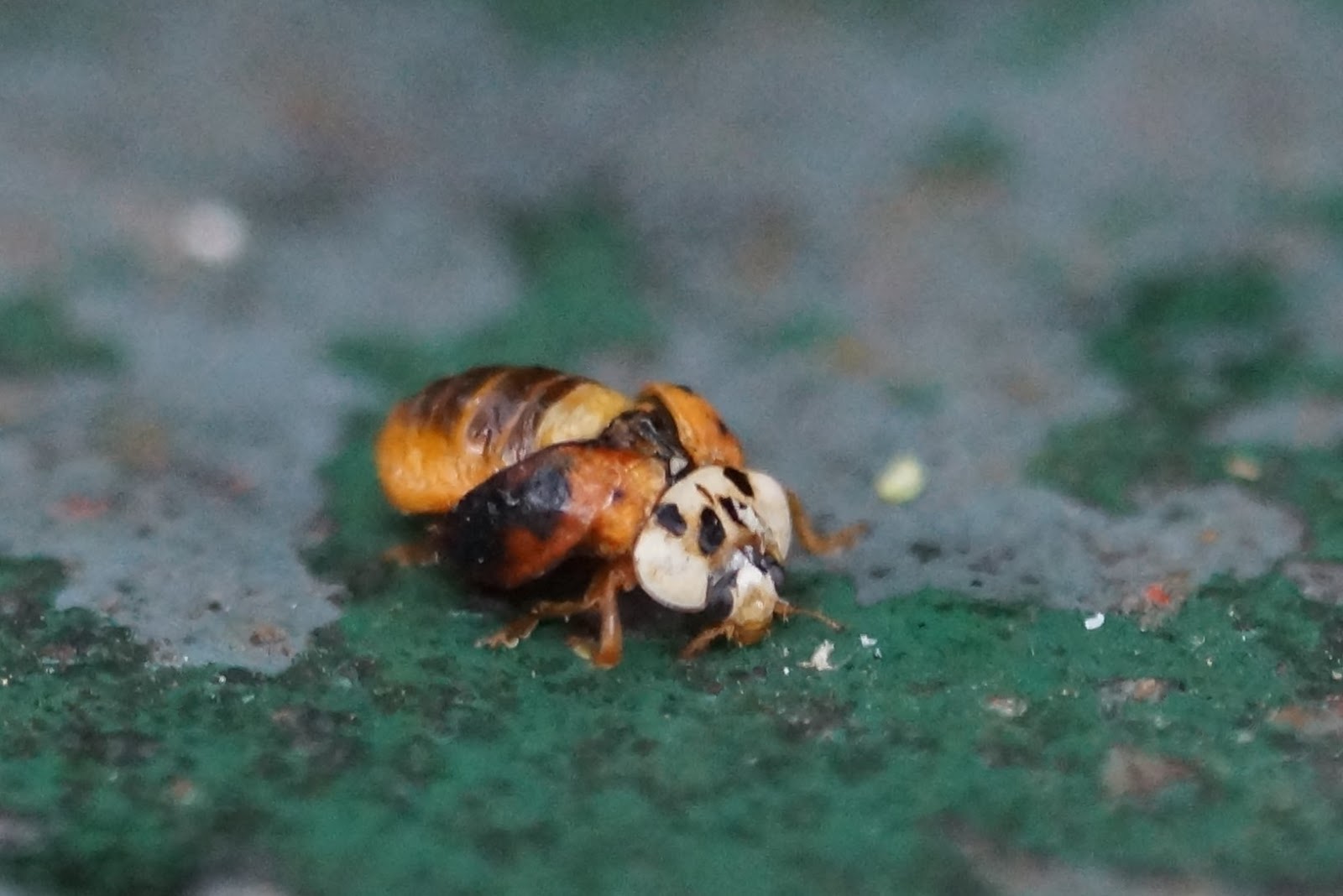
I also found another damaged one (just like the one I found a couple of weeks ago in the same place) and can only conclude they had pupated somewhere on the posts, maybe a 'crease' where one post joins another, and during emergence the wings have hardened against the metal and become deformed.....


It was very much alive and running around eating aphids that had dropped from the overhanging branches. Sadly it will never fly though, and will soon become easy prey for a bird.
 
I didn't see the Kingfisher today but I did see Red Kite, two Kestrels, Common Buzzard and Green Woodpecker. There were also several fairly large mixed flocks of Blue Tit, Great Tit, Chiffchaff and Goldcrest moving through the woods.


Sunday, 28 August 2016

The King is back at Cranford Park

Yesterday Nathalie and I were at the stone bridge at Cranford Park looking for the Kingfisher. Instead we found two Spotted Flycatchers.
This morning I was back at the stone bridge looking for the Spotted Flycatchers. Instead I had an hour long encounter with the Kingfisher !
 
This was my first view of him. An uncropped and unedited photo.
The shaded white area on the right is the bridge as I was trying my utmost not to disturb him by leaning too far over.....
 
 
He was literally just below me. If I moved he would have spotted me, so I had to make do with the view I had and be as quiet as possible....


He even caught a stickleback whilst I watched, but my only photo below, is out of focus...

 
But it was really lovely to have such good clear views, even if they were of an unusual angle....


After what seemed like hours, but was in fact just 40 minutes, he flew down river towards the M4 underpass and landed in the overhanging willows.
 
Spot the King....
 
 
A very heavily cropped shows him dead centre.

 
How can such a brightly coloured bird become so well camouflaged ?????
 
I took the advantage of him flying off to get myself in a better position should he come back, and although the view wasn't that much better, I had more a side view than looking down on him.
 
Within five minutes he was back....


And I spent another 20 minutes with this little stunner before he again flew down river, settling again in the same overhanging willows.....

 
We've known for the last few years that the Kingfishers are back, we've seen both male and female in previous years, but spotting them has been very hit and miss. I have only seen them a handful of times this year, and today were the best perched views I've had for over a year.
They don't nest down the main Cranford Park stretch of the River Crane, the river banks aren't high enough and to be honest I'm quite glad as disturbance to the birds would be very high with the amount of joggers and dog walkers that frequent the river walk.
I've always suspected they nest along the River Crane where it emerges from going under the M4. The banks there are very high, very secluded and there is very little in disturbance from walkers, joggers and dogs.
Overall it was just great to see one so close this morning.
 
There was no sign of the Spotted Flycatchers, they often don't stick around longer than a day or two during migration, but this charming Chiffchaff obligingly popped itself completely level with my camera on the nearest yellow lichen covered tree to the stone bridge....


Other birds seen from the stone bridge were a juvenile Robin, adult Robin, Song Thrush, several Blackbirds, male and female Blackcap, Goldfinches, Blue Tits, Great Tits, Long-tailed Tits and at least 10 Chiffchaffs. All of them on the yellow lichen covered trees to the left of the river if you look to the M4 from the stone bridge.
 
In between rain showers I had a nose around the woods. It was quite noisy with lots of Goldcrests, Long-tailed Tits, Blackbirds, Robins, Song Thrushes, Great Tits, Blue Tits, and 'Marmite' Parakeets calling, but I'm not complaining. My favourite woodland sound is birdsong.
 
I came across this 'thing' near the woods edge. It was small, the size of a 5p piece, and at first I thought it was a fallen berry but after nudging it with a stick I realised it was a fungi of some sort.
 
 
The log it is on has been in the same position at the woods edge for more years than I can remember. I often find bracket fungus on it later in the season, but I've never seen it fruiting this little red 'thing'. The jury is still out on what type of fungi it is, and all I can do is hope it is still there when I visit again next weekend.
 
In the Headland area as soon as the sun came out, so did the bugs......
 
This below is a Green Shield Bug, but it's not yet reached adult form. I think this is 4th instar stage, which in common language basically means it's a teenager rather than a grown adult....

 
The sun also bought out loads of Dock Bugs, mainly all adults but with the odd 'youngster'....


I like Dock Bugs. To me they are like tiny dinosaurs. The information below is from the UK Nature website....
 
With a length of 13-15 mm, Coreus marginatus is a fairly large bug, mottled reddish-brown in colouration with a broad, oval abdomen. Between the antennae are two small projections, known as antenniferous tubercles, which can be used to distinguish this species from other superficially similar species. Known as the dock bug as it feeds on the leaves and seeds of docks and sorrels. There is one generation per year, the adults mating and laying eggs in spring. The resulting nymphs feed on dock and other related plants with any new adults will be usually found from August onwards. Like other Coreidae the dock bug has an annual life cycle consisting of an egg followed by five successive nymphal instars before becoming an adult. It is often found in dense vegetation, such as hedgerows and wasteland and is common and widepread in southern Britain.
 
Even though my visit this morning was cut short at lunchtime after I got soaked three times in the showers, I had a great visit as always.
 
There was a first time visitor to the park this morning, who I got chatting to at the stone bridge. He had binoculars and was very knowledgeable about birds. I managed to show him the Kingfisher before it took flight and he advised me as to where he had seen another large gathering of Chiffchaffs. Unfortunately I didn't get his name, but I did give him one of my blog cards so hopefully he will read this later. Anyway the reason why I mention him is that it wasn't until I had been talking about the park, its wildlife and its history, that I realised this guy was genuinely interested. I had been waffling for ages and he was still listening.
Thank you mystery man. Sorry if I did go on a lot, but I am passionate about Cranford Park and what it has to offer. Thank you for listening and I hope to see you there again.